Growth
How to run your barbershop like a business people respect
Respect for a barbershop is built from small signals repeated every day: a door that answers questions, a price that does not change at the chair, a receipt, a start time that holds and a client who is remembered. None of it needs a bigger shop. Here are the do’s and don’ts, what each one costs to set up and a way to score your own shop.
Professional is a set of habits, not a size
A one-chair shop can look more established than a ten-chair one. Clients do not measure square footage. They notice whether the shop does what it said it would do, the same way, every time.
The first minute
Hours, prices and a way to get in line, visible before anyone asks.
One price
The price on the sign is the price at the chair.
A record of every sale
A receipt, every time, with the tip on its own line.
A start time that holds
Lateness and no-shows handled by a written rule, not mood.
A client who is remembered
Notes, history and the next visit booked before they leave.
Reviews and money
Ask everyone, answer everyone, keep the books apart from your pocket.
Score your shop on the six habits
Rate each habit from 0 (we do not do this) to 5 (every barber does it every day). This is your own honest rating, not a benchmark.
- Your score
- 18 / 30
- Weakest habit
- First minute
- Habits at 4 or more
- 0 of 6
Hover or tab to a column for the numbers.
| Rating | |
|---|---|
| First minute | 3 |
| One price | 3 |
| Receipts | 3 |
| Start time | 3 |
| Remembering clients | 3 |
| Reviews and money | 3 |
Your own ratings, added up. Fix the shortest bar first.
A self-rating helps you choose what to fix first. It is not a measure of how clients see you.
The first minute: what the door says before you do
Most people decide how much to trust a shop before they speak to anyone. They read the door, the window, your Google listing and the lobby.
Do
- The same hours on the door and on Google
- Prices on one clean sheet
- A QR code that says “Scan to get in line”
- A clean lobby and a screen that shows who is up
Don’t
- A handwritten “back in 10” note
- A crossed-out price list
- A clipboard nobody is watching
- A TV playing nothing
Try this today
Stand outside your door for one minute as a stranger. Write down every question the door does not answer, then fix the top three. For the online half, see our guide to a Google Business Profile for a walk-in shop.
Ten habits you can set up this week
| Write a note after each visit | Clients | 2 | You are remembered |
|---|---|---|---|
| Pick one greeting and one goodbye for the team | Clients | 5 | Every chair is the same shop |
| Post the same hours on the door and on Google | First minute | 10 | We are open when we say |
| Offer a receipt on every sale | Money | 10 | This is a business |
| Ask every client to rate their visit | Reviews | 10 | We want to hear it |
| Put a QR code to join the line on the door | First minute | 15 | Your time is respected |
| Add a visible cleaning routine at each chair | First minute | 15 | Care is standard |
| Post prices on one clean sheet | Price | 20 | No surprises |
| Write a one-paragraph lateness and no-show rule | Time | 20 | The start time is real |
| Open a business-only account | Money | 60 | The shop is its own thing |
Minutes are our rough estimate of the one-time setup, not a measurement. Your shop may take more or less.
One price, said once
The fastest way to lose a client’s respect is a price that changes at the chair. A client quoted $35 and asked for $50 does not remember the cut. They remember the surprise.
Do
- List every service and every add-on
- Say the total before starting an add-on
- Ask for the tip at the end of the sale
- Make offers a written rule: a first-visit price, a package, a membership
Don’t
- Quote one price and charge another
- Discount on the spot for whoever asks
- Charge a regular differently with no reason
- Turn the tip into a conversation
Try this today
Put your price list in a clean frame and hold yourself to it for a week. If you run offers, memberships and packages turn a discount into a rule.
A receipt for every sale
A receipt is the smallest piece of paper in the shop and the one that says “business” loudest. It shows the client what they paid for, gives you a record and ends any later argument about the total.
Do
- A receipt on every sale, emailed or printed
- Every service itemized, the tip on its own line
- The same figures on the page, the email and the print
- A look at the day’s total every night
Don’t
- Cash with no record
- The day’s numbers kept in your head
- A total re-typed by hand
- Adding it all up on Sunday
Protect the start time
Your time is the product, so a start time that does not hold is a broken product. Two things break it: clients who do not show, and clients who arrive late and expect the full service.
Do
- One written rule for lateness and no-shows, where people book
- A card on file or a deposit for booked services
- A clear quote and a live place in line for walk-ins
- A waived fee as a decision, not a mood
Don’t
- Exceptions by mood
- Arguing the rule at the chair
- Letting a late client cost the next one their time
- Leaving a no-show unrecorded
Try this today
Write the rule in three sentences and put it on your booking page. Our no-show policy template has wording to adapt. Then use the calculator below to see what the leaks cost.
What the small leaks cost you in a year
Three habits that read as unprofessional also cost real money. Enter your own numbers: the result is arithmetic, not a forecast.
- Lost in a year
- $24,080
- Lost in a week
- $463
- Biggest leak
- Walk-outs
Hover or tab to a column for the numbers.
| Lost sales | |
|---|---|
| No-shows | $7,280 |
| Walk-outs | $10,920 |
| Drifting regulars | $5,880 |
Example arithmetic: no-shows and walk-outs × ticket × 52 weeks; drifting regulars × 12 months × visits a year × ticket × one half.
Assumes every no-show and walk-out was a full ticket and that a drifting regular is lost for half the year on average. Your own counts will differ; the point is to see which leak is largest.
Remember your clients
Being remembered is the most personal thing a business can do, and the cheapest. A client who hears “same as last time, number 2 on the sides?” feels known, and that brings them back when three closer shops are open.
Do
- A note after each visit: the cut, the chair, the products they asked about
- The next visit booked before they leave the chair
- Notes kept in the shop’s record, not one phone
- Returning clients greeted by name
Don’t
- Relying on one barber’s memory
- Hoping they come back
- Asking the same questions every visit
- Letting regulars drift with no follow-up
Try this today
After each cut, write one line: what you did and one thing they said. See rebooking a client in seconds and barbershop client retention.
Hover or tab to a column for the numbers.
| Sales a year | |
|---|---|
| Every 6 weeks | $315 |
| Every 4 weeks | $455 |
| Every 3 weeks | $595 |
| Every 2 weeks | $910 |
Example arithmetic: a $35 ticket × visits a year (52 ÷ weeks between visits, rounded). Your ticket and your regulars will differ.
Reviews: ask every client, answer every review
A review page is a public notice board for your reputation. A recent, answered page looks open for business. A few old reviews and no replies look closed, or careless.
Do
- Ask every client, not only the happy ones
- Send everyone to the same place to post
- Reply to every review, by first name
- Reply to a bad review once, calmly, with what you will do
Don’t
- Hide the link from unhappy clients (review gating, which Google’s policies prohibit)
- Argue in public
- Reply in anger: write it, wait an hour, read it again
- Leave reviews unanswered for months
Try this today
Ask in person as the cut ends, once. Our guide to getting more Google reviews covers when and how.
Money habits that make a shop look, and be, established
The money side is the least visible and the one that decides whether the shop lasts. Clients never see it. Landlords, lenders and your future self do.
Do
- A separate business account
- Pay yourself on a schedule
- Set aside a share of every payment for taxes
- Keep your receipts and records
Don’t
- Mix personal and shop spending
- Take cash when you feel like it
- Wait for the tax bill to learn the number
- Run the shop out of one pocket
The right tax share depends on where you are and how the business is set up. The IRS’s small business pages are the place to start. For the personal money side of a barber’s life, David Chilton’s The Wealthy Barber has been recommended to generations of shop owners. This guide is about the shop.
Do and don’t, on one page
Sort or filter the table by area, pick the two or three habits your shop does least well and fix those first.
Do and don’t: the shop on one page
| Clients | A note after every visit | Keep it in one barber’s head | The shop remembers |
|---|---|---|---|
| Clients | Book the next visit before they leave | Hope they come back | A regular is a plan |
| First minute | Same hours on the door and Google | Leave a handwritten “back in 10” | It shows the shop is planned |
| First minute | A QR code to get in line | A clipboard nobody watches | Walk-ins can see their place |
| First minute | A clean lobby and a working screen | A TV playing nothing | Care is visible |
| Money | A receipt on every sale | Cash with no record | A record ends arguments |
| Money | A business account and a pay schedule | Mix personal and shop spending | Numbers you can trust |
| Price | Every service and add-on listed | Quote one price, charge another | No surprises at the end |
| Price | Say the total before an add-on | Discount on the spot for whoever asks | One price for everyone |
| Reviews | Ask everyone, reply to every review | Hide the link from unhappy clients | An answered page looks open |
| Reviews | Reply once, calmly, to a bad review | Argue in public | Calm reads as confident |
| Team | The same greeting at every chair | A different shop at every chair | One standard |
| Time | A written lateness and no-show rule | Exceptions by mood | The start time holds |
| Time | A card or deposit for booked services | Argue the rule at the chair | The rule does the work |
Sort by any column, or type an area such as Price or Reviews in the filter.
How NextUp Walk-in handles it
You can build all of this with a clipboard and a notebook, and many good shops did. The NextUp app does the repeating parts so the habits hold on a busy Saturday.
The first minute
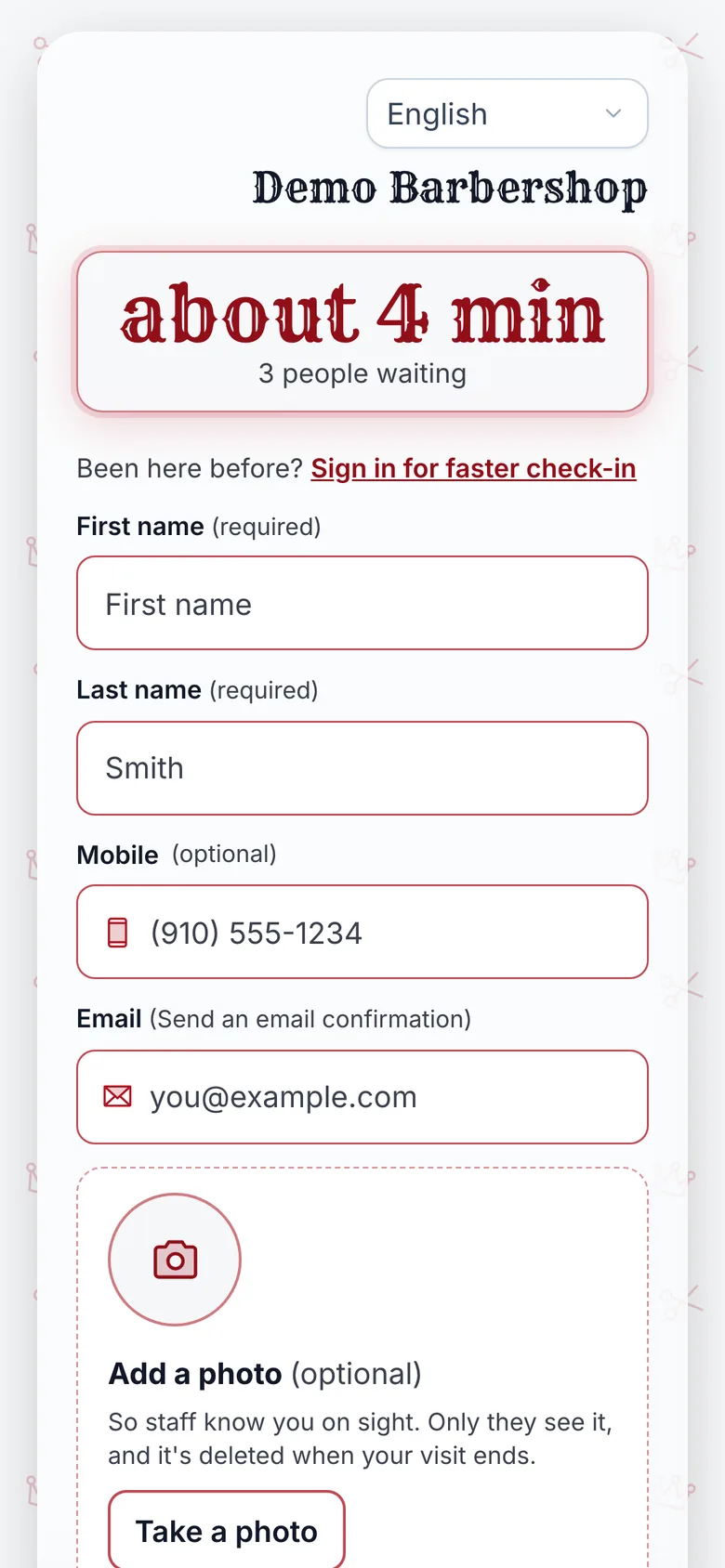
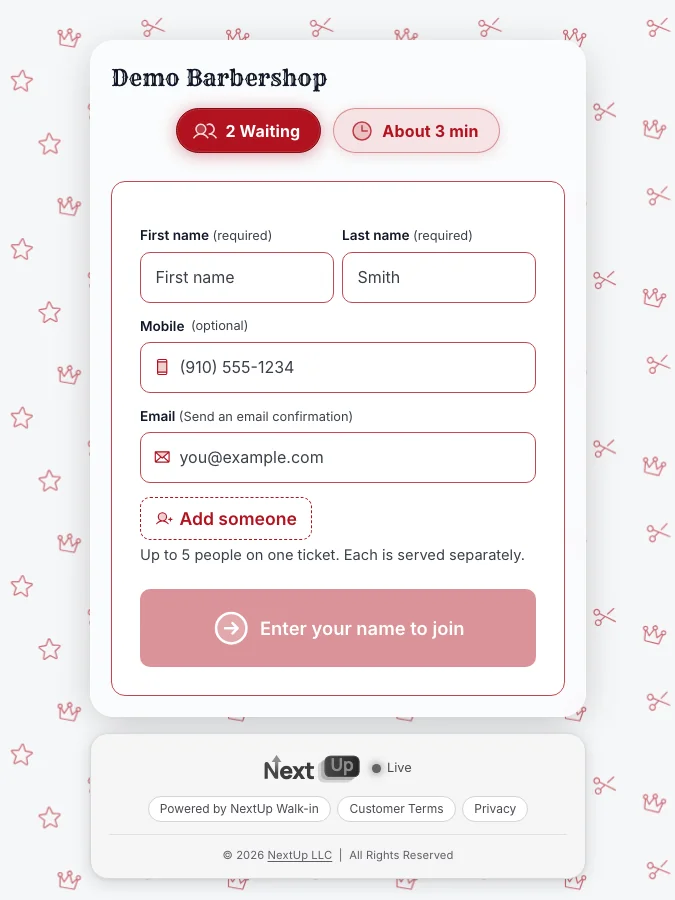
A QR code for the door, a lobby TV that shows who is up and a door tablet. Walk-ins join without an app download.
Get found
Your link, your QR code and the steps to put the line on Instagram, Google, Apple Maps and Yelp.
Receipts
Payment at the chair with an emailed receipt, or print 80mm or 58mm from your own device, with the same figures every time.
Client profiles
Built from check-ins: visit history, private team notes and a Reliable, Mixed or Often misses mark.
Reviews
A private rating for 24 hours after a visit, then your Google link for everyone who rates. No review gating.
No-show protection
A card on file or a deposit at booking, and refunds when a client cancels in time. You decide every no-show fee.
See NextUp app for barbershops, Get Found Online, client profiles, no-show protection, reviews and feedback, receipt printing.
The Walk-in plan is $29 a month for your first location and Pro is $59. There is also a Free plan: 1 location, 1 team member and 50 check-ins a month, and no card needed. Every paid plan starts with a 14-day free trial, once per business. A card is needed to start, but nothing is charged until the trial ends, when the plan is charged unless you cancel first. See pricing.
Start with the front door
Questions
How do I make my barbershop look more professional?
Start with the first minute: the same hours on the door and Google, posted prices and a way to join the line. Then add a receipt on every sale, a written no-show rule, notes on every client and a rating request after every visit.
Should a barber give a receipt for every haircut?
Yes. A receipt gives the client a record, gives you a record and ends any later argument about the total. It can be emailed or printed, with the tip on its own line.
How do I handle no-shows without losing clients?
Write one short rule, put it where people book and apply it to everyone. A card on file or a deposit makes it real for booked services. Waive a fee as a decision, not by mood.
Is it okay to only ask happy clients for reviews?
No. Ask everyone and send everyone to the same place. Hiding the review link from unhappy clients is review gating, which Google’s policies prohibit.