Industry Guides
Tax office walk-ins: a tax season plan you set up before January
For most tax offices, the year is decided in about twelve weeks. From late January to April 15 the lobby fills up, two-minute document drop-offs wait behind two-hour business returns, preparers stop mid-return to answer “how much longer?”, and anyone who gives up walks to the office down the street. This is a plan for running that line, set up in the quiet months so March runs itself.
Why tax season breaks a paper sign-in sheet
A tax office line is not one kind of visit. A W-2 return with no surprises, a self-employed return with a shoebox of receipts, an amended return, a client who only wants to drop off documents, and a client with “just one quick question” all sign the same clipboard. On paper they look the same, so every wait you quote is a guess, and the guess is wrong by an hour by noon.
Then the season adds pressure: everyone wants to file as soon as the IRS opens filing season in late January, and again in the last two weeks before the April 15 deadline. Your lobby has chairs for a normal Tuesday, not for those weeks.
The fix is to sort the visits at the door, let people wait somewhere other than your lobby, and get the paperwork done before the client reaches a desk.
Set it up in the fall, not the week you open
October to December is the time to decide the rules, because nobody is waiting yet. Four decisions cover most of it.
1. Your service menu, with honest times. NextUp Walk-in’s tax preparation starter menu already has individual, itemized, self-employed or gig, business and amended returns, extensions, IRS or state letter help, ITIN applications, a free document drop-off and a “quick question”, plus state return and per-dependent add-ons. Change each one to your office’s real times (time a few on a quiet day). Each service counts for its own time in the wait, and can show a “From” price so the fee conversation starts before the desk. 2. A line cap and a closing time, so you stop taking full returns before close on April 14 and don’t promise more than your preparers can finish. 3. Whether clients can pick a preparer. 4. Which form every client signs before joining.
Keep two-minute drop-offs out of the two-hour line
The single biggest win is giving document drop-offs their own short service. A drop-off then counts for only a few minutes in the wait, and the front desk can call drop-offs up between full returns. The client who only needed to hand over a folder is out in five minutes instead of an hour, and the client waiting for a full return sees a wait that stays true.
Do the same for “quick question” visits.
Get the fee agreement signed before anyone sits down
Fee surprises cause more bad reviews than slow returns. The tax preparation agreement from the starter forms covers filing jointly, the spouse’s name and what is new this year, and has the client confirm that their documents are complete, that the fee was explained before work began, and that they review the return before it is filed. Make it required, and it is signed on the client’s phone or the front-desk tablet before they join, then filed on their profile.
No Social Security numbers go on the form, and no tax documents are uploaded to NextUp Walk-in. Those stay in your tax software, where they belong. See digital waivers and forms for how signed forms work.
Renew every PTIN before December 31
Every paid preparer needs a current Preparer Tax Identification Number, and PTINs expire on December 31 each year. Renewals open in the fall, and a preparer who forgets one finds out at the worst possible time.
Licences and insurance on each team member’s page (every plan) has PTIN and EFIN among the credential types for tax offices. Add each preparer’s PTIN with its expiry date, and owners (and the preparer) get an email 30 days and 7 days before it lapses. The same list covers liability insurance and anything else you track under “Other”. More in licences and insurance tracking.
Let clients wait in the car, or at home
Clients join from a QR code on the door, the link on your Google profile or website, or the front-desk tablet in kiosk mode, which never keeps one client’s details for the next. No app and no account. Their place and wait stay live on their phone, so they can run an errand and come back when they are close.
With “Where are you waiting?” (on by default), a client can say they are inside, outside or in their car, with a short car description. Your desk sees a car badge on that row, so nobody shouts names into an empty lobby. When the wait is over 10 minutes, the join page offers “Tell me when the wait is shorter”, so people who would have left come back later instead.
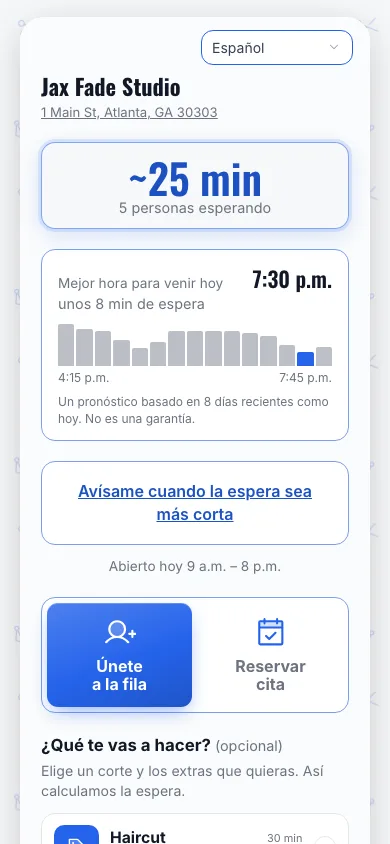
Once your office has a few days of history, the join page also shows “Best time to come today”: the lowest expected wait for each quarter-hour of the rest of the day. On a March Saturday that alone spreads out the crowd. More on these in how to cut walk-in wait times.
Returning clients, last year’s preparer and six languages
Many clients want the preparer who did their taxes last year. Turn on preparer choice and they pick that person and see that preparer’s own wait, next to “First available” for anyone who just wants the next open desk. If Maria is 50 minutes out and First available is 15, the client chooses with real numbers.
Tax offices often serve families who are more comfortable in another language. The join page, door tablet and spot-in-line page work in Spanish, Vietnamese, Korean, Portuguese (Brazil), Haitian Creole and Simplified Chinese, and remember each client’s pick. See six languages at the door.
Walk-ins and booked returns side by side (Pro)
Business returns and complicated ones are better booked. With Pro, clients book a time with a preparer beside the walk-in line, with email reminders 24 hours and 1 hour before (text reminders once texting is live). Deposits and a card on file for the long slots are coming soon with card payments. Keep the walk-in line for drop-offs, simple returns and questions, and you stop choosing between the two.
After April 15: plan next season with real numbers
Insights keeps the season’s busiest hours by weekday, average and quoted versus real waits, and how many people left the line. That is your staffing plan for next March. Ratings with your Google review link turn finished returns into reviews while the client is still relieved.
With Pro, email campaigns include tax-office templates to send in January to clients who opted in (“Book your return”), and commissions and payroll files help with seasonal preparers.
Plans are on pricing: Walk-in is $29 a month for your first location ($19 for each one after), Pro is $59 and $39, and both include 3 team members per location, then $10 a month each (seasonal preparers included). The 14-day free trial has every Pro feature. Coming from another app, the code SWITCH gives your first month free on monthly billing. More on the tax preparation page.
Questions
How do tax offices handle walk-ins during tax season?
Sort visits at the door by service, give document drop-offs their own short service, get the fee agreement signed before the client joins, and let clients wait anywhere with a live place in line.
Can clients drop off documents without waiting behind full returns?
Yes. A document drop-off service counts for only a few minutes in the wait, and staff can call drop-offs up between returns.
When do PTINs expire?
On December 31 each year. Track each preparer’s PTIN with its expiry date under Licences and insurance, and NextUp Walk-in reminds you before it lapses.
Do clients upload tax documents or Social Security numbers?
No. The fee agreement has no SSN field, and documents stay in your tax software.
Can we take walk-ins and booked returns together?
Yes, with the Pro plan. Booked returns sit beside the walk-in line, with reminders before each appointment.